

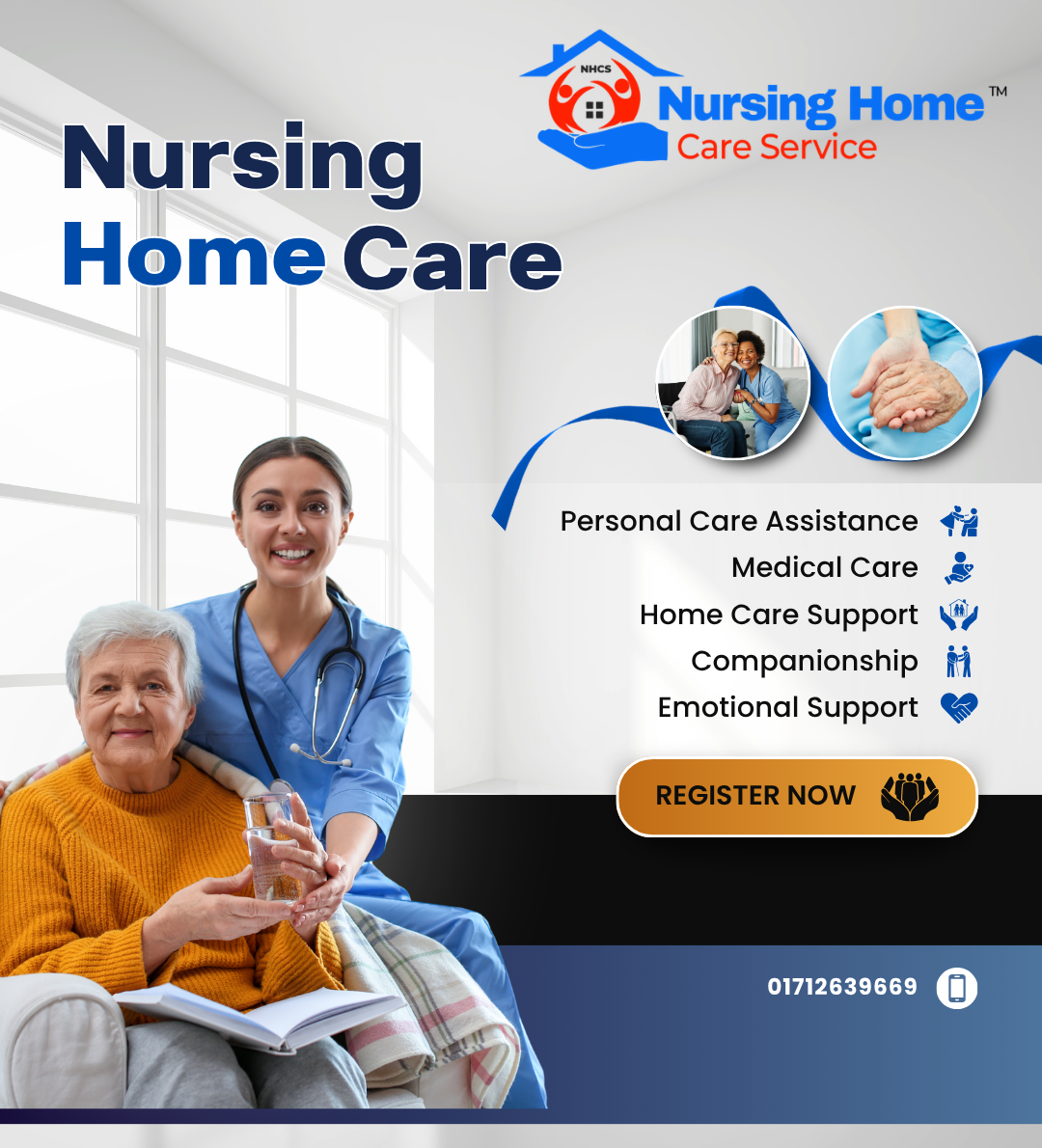
When a parent can no longer manage the stairs alone, when a stroke leaves a husband unable to speak clearly, or when a hospital discharge letter says “requires daily wound care” — most Bangladeshi families face the same question: who is going to provide this care, every day, correctly, at home?
Nursing Home Care Service exists to answer that question. We provide professional nursing home care in Dhaka and across Bangladesh, sending trained nurses and caregivers directly to a patient’s home so families don’t have to choose between a hospital bed and their loved one’s comfort. Whether the need is a few hours of daily support or round-the-clock nursing home care, our team is built around one goal: keeping patients safe, comfortable, and properly cared for in the place they know best — home.
This page explains exactly what nursing home care means in the Bangladeshi context, who needs it, what our nurses actually do, and how to decide if home nursing is the right choice for your family.
What Is Nursing Home Care, and Why It Matters in Bangladesh
Nursing home care is a home-based healthcare service where a qualified nurse or trained caregiver visits — or stays with — a patient to provide medical and personal support that would otherwise require a hospital stay or a residential care facility.
In Bangladesh, this model matters for reasons that are very specific to how families and hospitals here actually work:
- Hospital beds are limited and expensive to hold onto. Once a patient is medically stable, hospitals in Dhaka encourage discharge — but “stable” doesn’t always mean the family is ready to manage catheters, feeding tubes, or wound dressing on their own.
- Joint families are shrinking. Adult children increasingly work full-time or live abroad (NRB families), leaving aging parents without a family member available all day to provide hands-on care.
- Residential nursing homes are still uncommon and culturally unfamiliar. Most Bangladeshi families prefer to keep elderly or sick relatives at home rather than move them into an institution — nursing home care lets the “home” stay a home while still delivering hospital-level clinical support.
- Chronic and age-related illness is rising. Stroke, diabetes, and cardiovascular disease are increasingly common in Bangladesh’s aging population, and most of this care is long-term, not a one-time hospital event.
Nursing home care bridges that gap — professional, clinically trained hands, delivered inside the patient’s own bedroom.
Who Needs Nursing Home Care
Nursing home care isn’t only for the very elderly. It’s for anyone whose daily health needs exceed what family members can safely manage alone. This typically includes:
Elderly and age-related needs
- Senior citizens who live alone or whose children are abroad or working full-time
- Elderly patients with limited mobility who need help bathing, dressing, and moving safely
- Patients showing early or advanced signs of dementia or Alzheimer’s who need supervised, patient care
Post-hospital and post-surgical needs
- Patients discharged from hospital who still need wound checks, medication schedules, or vitals monitoring
- Post-surgery and orthopedic patients recovering from fractures or operations
- ICU-recovery and critical care patients who need close observation at home instead of an extended hospital stay
Condition-specific needs
- Stroke and paralysis patients who need physical support, repositioning, and rehabilitation exercises
- Parkinson’s and dementia patients who need consistent routine and safety supervision
- Cancer and palliative/terminally ill patients who need comfort-focused, dignified care
- Diabetic patients who need medication timing, diet monitoring, and wound care (diabetic wounds heal slowly and need trained attention)
Procedure and equipment-based needs
- Patients with a Ryles tube, PEG feeding tube, or catheter who need trained handling to avoid infection
- Tracheostomy patients who need suctioning and airway care
- Patients requiring scheduled IV infusion or injections at home
- Patients on home oxygen who need a concentrator or cylinder managed safely
If your family is currently trying to coordinate any of the above without medical training, that’s the exact situation nursing home care is built to solve.
What Our Nursing Home Care Includes
Clinical nursing support
- Vitals monitoring — blood pressure, blood sugar, oxygen saturation, temperature
- Medication management and timing
- Wound dressing and post-surgical wound care
- Catheter care, tracheostomy care, and feeding tube (Ryles tube / PEG) management
- Injection administration and IV infusion support, as prescribed by the treating physician
- Bathing, grooming, and personal hygiene assistance
- Mobility support — helping patients move safely, reposition in bed, and prevent bedsores
- Feeding assistance, including tube feeding where required
- Companionship — a meaningful part of care for patients who spend most of the day alone
Specialized care tracks
- Stroke and paralysis care, focused on safe repositioning and rehabilitation support
- Dementia and Alzheimer’s care, with an emphasis on routine, patience, and safety
- Palliative and terminally ill patient care, centered on comfort and dignity
- Diabetic patient care, including foot and wound checks specific to diabetic complications
Support services
- Male nurse or female nurse placement, based on patient and family preference
- Day shift, night shift, or full 24/7 nursing home care
- Short-term care (post-surgery recovery, a family trip, a temporary gap) and long-term care arrangements
- Coordination with the patient’s existing doctor so care stays aligned with the treatment plan
How Nursing Home Care Works — Our Process
1. Initial consultation. We start by understanding the patient’s condition, current diagnosis, mobility level, and any specific medical needs — usually over a phone call.
2. Care plan and nurse matching. Based on that assessment, we match the patient with a nurse or caregiver whose experience fits the case — for example, a nurse experienced in tracheostomy care for a tracheostomy patient, not a general caregiver.
3. Schedule confirmation. Families choose the shift pattern that fits their situation: a few hours a day, day and night shifts, or full-time live-in nursing home care.
4. Care begins at home. The assigned nurse or caregiver starts providing care according to the agreed plan, following any instructions from the patient’s treating doctor.
5. Ongoing monitoring and communication. For clinical cases, we keep the family updated on the patient’s condition and flag anything that needs a doctor’s attention promptly rather than waiting for a scheduled check-in.
Signs Your Family Should Consider Nursing Home Care
It’s not always obvious when informal family care has stopped being enough. Common signals include:
- A hospital discharge summary lists ongoing care needs (dressing changes, tube feeding, medication schedules) that no one in the family has been trained to handle
- The primary family caregiver is exhausted, working full-time, or living in a different city or country
- The patient has fallen, or is at real risk of falling, when left alone
- Medication is being missed or given at the wrong times
- A wound, catheter, or feeding tube isn’t being checked regularly and there’s visible irritation, redness, or infection risk
- The patient is increasingly withdrawn, confused, or unsafe when left without supervision
If two or more of these apply, it’s worth a conversation about nursing home care before a small problem becomes a medical emergency.
Why Choose Us
- Trained nurses and caregivers, matched to the specific medical needs of the case rather than assigned generically
- Flexible scheduling — hourly, daily shift, or 24/7 nursing home care, adjusted as the patient’s condition changes
- Coordination with the patient’s doctor, so home care stays aligned with the actual treatment plan rather than working in isolation
- Service across Dhaka, including Uttara, Gulshan, Banani, Bashundhara, Dhanmondi, Mirpur, Mohammadpur, Badda, Rampura, Malibagh, Motijheel, Old Dhaka, and nearby areas such as Savar, Gazipur, and Narayanganj
- A single point of contact for families, so you’re not re-explaining the patient’s condition to a different person every time
Safety and Quality Standards
Every placement is based on matching the patient’s actual medical needs to a nurse or caregiver’s specific experience — a dementia case is not staffed the same way as a tracheostomy case. Care instructions follow the treating physician’s plan rather than operating independently of it, and families are kept informed of the patient’s condition on an ongoing basis rather than only at scheduled intervals. If your family has specific requirements — a preference for a male or female nurse, a particular shift pattern, or a language preference — raise it during the initial consultation so the care plan reflects it from day one.
Service Areas in Dhaka and Beyond
We provide nursing home care across Dhaka — including Uttara, Gulshan, Banani, Bashundhara, Dhanmondi, Mirpur, Mohammadpur, Badda, Rampura, Malibagh, and Old Dhaka — as well as nearby districts including Savar, Gazipur, and Narayanganj. If you’re outside these areas, contact us directly to check current availability in your location.
Cost of Nursing Home Care in Bangladesh
Nursing home care pricing depends on several factors: the level of care required (companionship vs. clinical nursing), whether the placement is hourly, day-shift, night-shift, or full 24/7 live-in care, and the duration of the engagement (short-term recovery vs. long-term arrangement). Because these variables change the cost significantly from one case to another, we provide a specific quote after the initial consultation rather than a fixed public rate — this ensures the price you’re given actually reflects your patient’s real care needs rather than a generic package.
Frequently Asked Questions
1. What is the difference between a nursing home and nursing home care at home? A traditional nursing home is a residential facility where the patient moves in permanently. Nursing home care, as we provide it, brings the nurse or caregiver to the patient’s own home, so the patient stays in a familiar environment while still receiving trained medical and personal support.
2. Is nursing home care available 24/7 in Dhaka? Yes. We offer flexible scheduling, including hourly visits, single day or night shifts, and full 24/7 nursing home care for patients who need continuous supervision.
3. Can I request a male or female nurse specifically? Yes, family and patient preference for a male or female nurse is taken into account during the initial consultation and matching process.
4. Do your nurses handle feeding tubes, catheters, and tracheostomy care? Yes, our nurses are matched to cases based on relevant experience, including Ryles tube/PEG feeding, catheter care, and tracheostomy management, under the guidance of the patient’s treating physician.
5. What if the patient’s condition changes after care begins? Contact us and we’ll reassess the care plan and, if needed, adjust the assigned nurse’s shift pattern or clinical focus to match the patient’s new condition.
6. Do you provide short-term nursing care, or only long-term placements? Both. Short-term care is common for post-surgery recovery, temporary family travel, or a defined recovery period, while long-term care suits chronic or age-related conditions.
7. How quickly can nursing home care start after I contact you? This depends on current nurse availability and the complexity of the case. Contact us directly with the patient’s details so we can give you an accurate timeline for your specific situation.
8. Does nursing home care replace the need for a doctor? No. Nursing home care supports the treatment plan set by the patient’s doctor — it does not replace medical diagnosis or treatment decisions, which remain with the physician.
9. Can nursing home care help prevent another hospital admission? Consistent monitoring of vitals, medication timing, and wound or tube care at home can help catch problems early, which is one of the main reasons families choose nursing home care after a hospital discharge — though it cannot guarantee that a readmission won’t be needed.
10. Is nursing home care only for elderly patients? No. While elderly and senior care is a large part of what we do, nursing home care also supports younger patients recovering from surgery, injury, stroke, or managing chronic conditions like diabetes or cancer.
11. What areas of Dhaka do you serve? We currently serve Uttara, Gulshan, Banani, Bashundhara, Dhanmondi, Mirpur, Mohammadpur, Badda, Rampura, Malibagh, Old Dhaka, and nearby areas including Savar, Gazipur, and Narayanganj. Contact us to confirm availability for your specific location.
12. How is the cost of nursing home care determined? Cost depends on the shift pattern (hourly, day, night, or 24/7), the level of clinical care required, and the length of the engagement. We provide a quote based on your specific case after the initial consultation.
Call to Action
If a family member needs daily support that’s grown beyond what you can safely manage alone, don’t wait for a crisis to make the decision. Contact Nursing Home Care Service today for a consultation, and let’s put together a nursing home care plan that fits your loved one’s actual condition — at home, in Dhaka, with people trained to do this properly.