

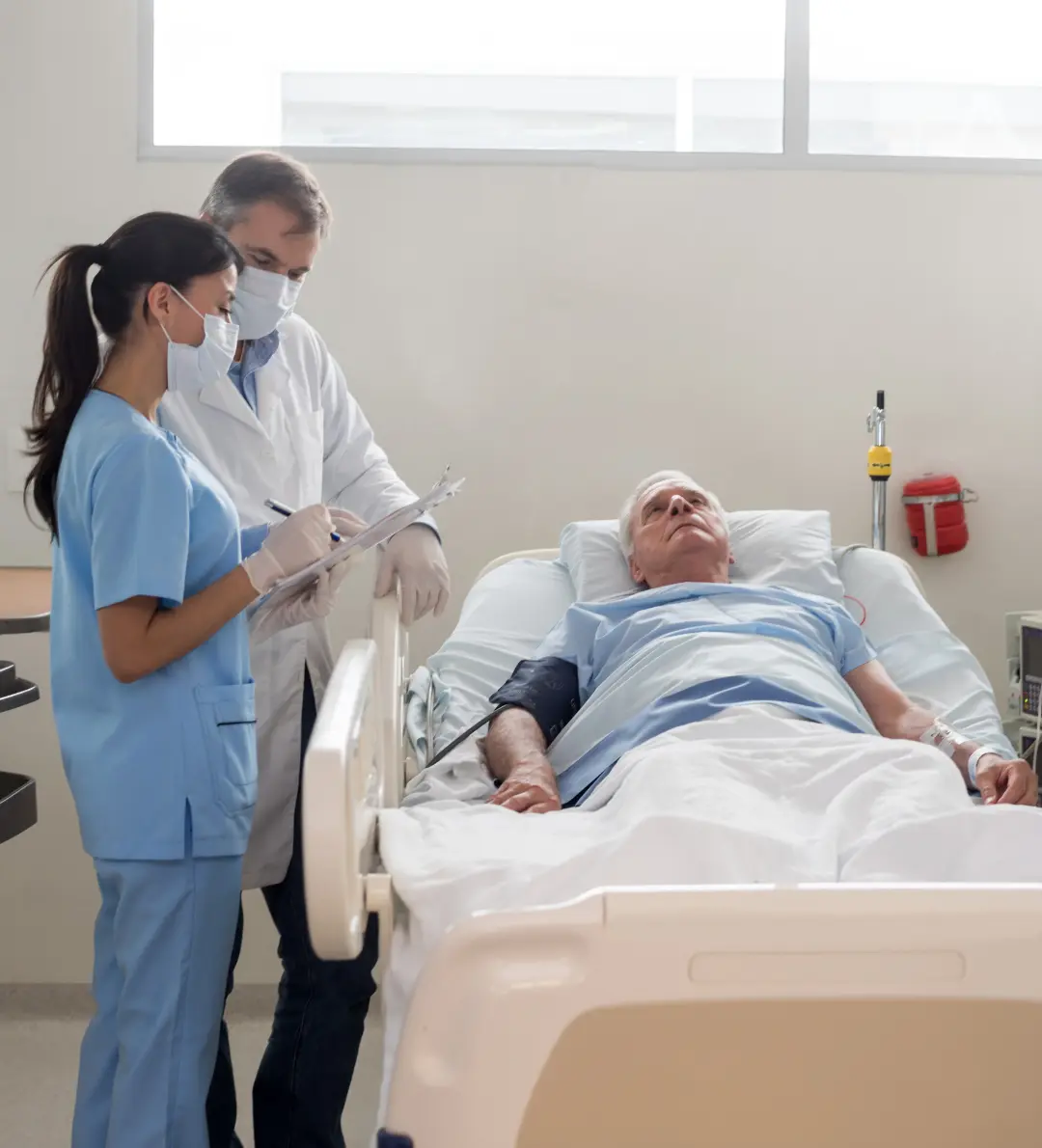
ICU Patient Care Service in Dhaka | Trusted Critical Care
When a loved one needs intensive care, the hospital ICU can feel like the only safe place — but prolonged ICU stays bring high costs, infection risk, and the emotional toll of separation from family. Many patients on a ventilator, tracheostomy tube, or continuous oxygen therapy can be cared for safely at home, with the right medical team in place. That’s where a professional ICU patient care service makes a real difference.
Nursing Home Care Service provides skilled critical care nurses and caregivers trained to manage ICU-level needs at home in Dhaka — including ventilator care, tracheostomy suctioning, oxygen therapy, feeding tube management, and continuous vital signs monitoring. Whether your loved one is being discharged from the ICU or needs ongoing high dependency care for a chronic critical condition, our team brings hospital-standard protocols into your home, under coordination with the patient’s treating doctor.
This guide explains everything families in Dhaka need to know about ICU patient care service — what it involves, who qualifies for home-based critical care, how it works, safety precautions, cost, and how to arrange support quickly, including emergencies.
Quick Answer
An ICU patient care service provides skilled critical care nurses who manage ventilator support, tracheostomy care, oxygen therapy, feeding tubes, and continuous vital signs monitoring for critically ill patients at home. In Dhaka, it’s used for patients discharged from the ICU or those needing ongoing high dependency care under coordinated medical supervision.
1. What Is an ICU Patient Care Service?
An ICU patient care service brings intensive, hospital-level nursing care into the patient’s home, managed by skilled critical care nurses trained in ventilator care, tracheostomy care, oxygen therapy, catheter care, and continuous patient monitoring. It’s designed for patients discharged from an Intensive Care Unit (ICU) who still require close medical supervision, or for chronically critical patients who need ongoing high dependency care without a prolonged hospital stay.
This service follows evidence-based protocols consistent with guidance from bodies like the Society of Critical Care Medicine, adapted safely for the home environment.
2. Benefits of Home ICU Patient Care
- Reduces prolonged hospital stays and associated infection risk
- Provides continuous, skilled monitoring in a familiar environment
- Supports faster emotional recovery through family presence
- Lowers overall cost compared to extended ICU hospitalization
- Offers personalized, one-on-one nursing attention
- Coordinates closely with the patient’s doctor for medical oversight
- Reduces strain on hospital ICU capacity for genuinely critical cases
3. Who Needs This Service
- Patients recently discharged from the ICU needing continued monitoring
- Ventilator-dependent patients requiring ongoing respiratory support
- Patients with a tracheostomy needing regular suctioning and airway care
- Stroke patients in critical recovery phases
- Cancer patients with complex, high dependency needs
- Elderly patients with multiple chronic conditions requiring close monitoring
- Bedridden patients at risk of pressure sores or infection
- Patients needing feeding tube (PEG tube or Ryles tube) management
4. Signs You Need ICU-Level Care at Home
- The patient requires ventilator or oxygen therapy support continuously
- There’s a tracheostomy tube requiring regular suctioning and care
- Vital signs need frequent, skilled monitoring (blood pressure, oxygen saturation)
- The patient has multiple IV infusions, catheters, or feeding tubes
- The treating doctor has approved home-based critical care as a discharge plan
5. When to Choose Home ICU Care Over Hospital Stay
Home ICU care is appropriate once a patient is medically stable enough for discharge but still requires ventilator support, tracheostomy management, or intensive monitoring that a general home nursing service isn’t equipped to handle. It offers a safe middle ground between full hospital ICU admission and standard home nursing, provided the treating doctor confirms the patient is a suitable candidate.
6. How Our ICU Patient Care Service Works
We begin with a detailed review of the patient’s ICU discharge summary and ongoing medical needs, then set up the required home ICU equipment and assign a skilled critical care nurse trained specifically in the patient’s condition, coordinating with the treating doctor throughout.
7. Step-by-Step Booking Process
- Contact us with the patient’s ICU discharge summary and condition details
- Medical assessment — our team reviews ventilator, tracheostomy, or monitoring needs
- Home ICU setup — equipment installation (hospital bed, ventilator, oxygen concentrator, monitors)
- Nurse assignment — a skilled critical care nurse is matched to the case
- Care begins — 24/7 or scheduled critical care nursing starts at home
- Ongoing coordination — regular updates and coordination with the patient’s doctor
8. What to Expect From Your Critical Care Nurse
- A trained, experienced nurse skilled in ICU-level protocols
- Continuous monitoring of vital signs, oxygen levels, and airway status
- Proper tracheostomy care, suctioning, and infection prevention practices
- Accurate medication administration and IV infusion management
- Clear, regular updates to family and the treating doctor
9. Service Features
- Skilled critical care nurses for home ICU management
- Ventilator care and oxygen therapy support
- Tracheostomy care and suctioning
- Feeding tube (PEG tube/Ryles tube) management
- Catheter care and wound dressing
- Continuous vital signs monitoring (pulse oximeter, blood pressure monitor)
- 24/7 ICU patient care service availability
- Coordination with the patient’s treating doctor
- Available across Dhaka, Bangladesh
10. Advantages of Home-Based Critical Care
Home ICU care significantly reduces exposure to hospital-acquired infections, allows for more personalized nurse-to-patient attention than a busy hospital ICU, and supports better emotional wellbeing for both patients and families — all while maintaining rigorous clinical monitoring standards.
11. Common Challenges in Home ICU Care
- Setting up and maintaining specialized equipment safely at home
- Ensuring uninterrupted power supply for ventilators and oxygen concentrators
- Coordinating consistent nurse shifts for true 24/7 coverage
- Managing family anxiety around complex medical equipment
- Quickly recognizing when a patient needs to return to hospital care
12. Safety Tips for ICU Patients at Home
- Maintain strict hand hygiene and sterile technique during tracheostomy or catheter care
- Ensure backup power sources for ventilators and oxygen concentrators
- Monitor pulse oximeter and blood pressure readings as scheduled
- Reposition bedridden patients regularly to prevent pressure sores
- Keep emergency contacts, the treating doctor, and nearest hospital information readily accessible
- Store medical equipment (oxygen cylinders, suction devices) safely and correctly
13. Common Mistakes to Avoid
- Attempting home ICU care without a doctor’s clearance for discharge
- Using untrained staff for ventilator or tracheostomy management
- Ignoring subtle changes in oxygen saturation or breathing pattern
- Inconsistent nurse shift coverage, leaving gaps in monitoring
- Delaying return to hospital when the patient’s condition deteriorates
14. Professional Recommendations
Bodies such as the Society of Critical Care Medicine and the World Health Organization emphasize that home-based critical care is appropriate only for stable, carefully selected patients under continuous skilled nursing supervision and clear medical oversight. Our critical care nurses coordinate closely with the patient’s doctor to ensure the care plan matches the exact clinical requirements.
15. Emergency Situations
Seek immediate hospital care if the patient shows:
- Sudden drop in oxygen saturation or worsening breathing difficulty
- Ventilator alarm indicating malfunction that cannot be immediately resolved
- Sudden unresponsiveness, seizure, or cardiac symptoms
- Signs of severe infection (high fever, spreading redness at tracheostomy or catheter site)
- Any rapid deterioration in vital signs
Home ICU patient care service supports stable, medically cleared patients — it does not replace hospital-level emergency intervention. Always contact a doctor or hospital immediately during a medical emergency.
16. Recovery Tips
- Follow the treating doctor’s discharge and care plan precisely
- Maintain consistent respiratory therapy and repositioning schedules
- Track vital signs and any changes in a daily log for the medical team
- Ensure proper nutrition through feeding tube or oral intake as advised
- Attend all scheduled follow-up appointments with the doctor
17. Patient Care Guidelines
- Maintain strict infection prevention protocols around all tubes and lines
- Monitor skin integrity closely to prevent pressure sores in bedridden patients
- Follow precise medication and IV infusion schedules
- Watch for early warning signs of respiratory or circulatory decline
18. Family Care Tips
- Learn basic safety checks for ventilator and oxygen equipment from the nurse
- Keep a shared log of the patient’s condition, medications, and doctor instructions
- Maintain calm, supportive communication with the patient
- Take breaks in shifts to avoid caregiver exhaustion during long-term critical care
19. Equipment Needed for Home ICU Setup
- Hospital bed with pressure-relief mattress
- Ventilator or oxygen concentrator, as prescribed
- Pulse oximeter and blood pressure monitor
- Suction machine for tracheostomy care
- IV infusion stand and related supplies
- Wheelchair, if mobility is required during recovery
- Backup power source for critical equipment
20. Cost of ICU Patient Care Service in Dhaka
Costs depend on the complexity of care — ventilator management and 24/7 skilled nursing cost more than standard monitoring. Request a personalized quote based on the patient’s specific ICU discharge summary and ongoing medical needs.
21. Service Availability & Booking
Nursing Home Care Service provides ICU patient care service across Dhaka, Bangladesh, including families in Banani and Malibagh, with 24/7 critical care nursing coverage and rapid home ICU setup available on request.
22. After Care
As the patient stabilizes, care can transition from intensive ICU-level support to standard home nursing service or physiotherapy-focused rehabilitation, with regular reassessment to match the care plan to the patient’s evolving condition.
Featured Snippet Box
Definition: An ICU patient care service provides skilled critical care nurses who manage ventilator support, tracheostomy care, oxygen therapy, feeding tubes, and continuous vital signs monitoring for critically ill patients at home — offering hospital-level care under coordinated medical supervision for patients discharged from the ICU.
Comparison Table: Home ICU Care vs. Hospital ICU Stay
Factor | Home ICU Patient Care | Hospital ICU Stay |
Infection Risk | Lower (controlled home environment) | Higher (hospital exposure) |
Cost Over Time | Generally lower | Higher, especially long-term |
Family Presence | Continuous | Limited visiting hours |
Nurse-to-Patient Ratio | One-on-one | Shared among multiple patients |
Best For | Medically stable, doctor-cleared patients | Acute, unstable critical conditions |
Pros & Cons: ICU Patient Care Service at Home
Pros | Cons |
Hospital-level monitoring in a familiar environment | Requires strict equipment setup and maintenance |
Reduces infection exposure risk | Not suitable for unstable, high-risk cases |
One-on-one skilled nursing attention | Higher cost than standard home nursing |
Coordinated with the patient’s doctor | Requires reliable backup power for equipment |
Checklist: Choosing an ICU Patient Care Service
- Nurses are skilled and experienced in ventilator/tracheostomy care
- Service coordinates directly with the patient’s treating doctor
- 24/7 coverage confirmed with reliable shift scheduling
- Home ICU equipment setup included or arranged
- Transparent pricing for complex, high dependency care
- Clear emergency escalation plan to nearest hospital
- Experience managing your specific critical condition
Equipment Checklist for Home ICU Setup
- Hospital bed with pressure-relief mattress
- Ventilator or oxygen concentrator
- Pulse oximeter & blood pressure monitor
- Suction machine
- IV infusion stand & supplies
- Backup power source
Patient Recovery Timeline (General Guide)
Stage | Typical Timeframe | Focus |
ICU Discharge Transition | Day 1–3 | Equipment setup, nurse assignment, baseline monitoring |
Stabilization at Home | Week 1–2 | Continuous monitoring, infection prevention |
Weaning Support | Week 2–6 | Gradual reduction of ventilator/oxygen dependency (if applicable) |
Post-ICU Rehabilitation | Ongoing | Transition to physiotherapy and standard nursing care |
Timelines vary significantly by condition — always follow the treating doctor’s individualized plan.
FAQs
- What does an ICU patient care service include?
An ICU patient care service includes skilled nursing management of ventilator support, tracheostomy care, oxygen therapy, feeding tubes, catheter care, and continuous vital signs monitoring for critically ill patients at home, coordinated with the patient’s treating doctor.
- Can ventilator patients be cared for at home in Dhaka?
Yes, medically stable ventilator-dependent patients can receive care at home through a skilled critical care nurse, provided the treating doctor confirms the patient is a suitable candidate for home-based ICU care.
- Is home ICU care as safe as hospital ICU care?
For carefully selected, stable patients, home ICU care can be safe when managed by skilled critical care nurses following strict protocols. However, unstable or rapidly deteriorating patients should remain in a hospital ICU setting.
- What is included in a home ICU setup?
A home ICU setup typically includes a hospital bed, ventilator or oxygen concentrator, pulse oximeter, blood pressure monitor, suction machine, and IV infusion equipment, tailored to the patient’s specific medical needs.
- How much does ICU patient care service cost in Dhaka?
Cost depends on the complexity of care, including whether ventilator management or 24/7 skilled nursing is required. Request a personalized quote based on the patient’s ICU discharge summary and ongoing needs.
- Who qualifies for home ICU patient care after hospital discharge?
Patients who are medically stable but still require ventilator support, tracheostomy management, or intensive monitoring, and who have been cleared by their treating doctor for home-based critical care, typically qualify for this service.
- Can tracheostomy care be managed safely at home?
Yes, skilled critical care nurses are trained in tracheostomy suctioning, cleaning, and infection prevention, allowing safe management at home under coordination with the patient’s doctor.
- What happens if a home ICU patient’s condition suddenly worsens?
The critical care nurse will immediately alert the family and the treating doctor, and the patient may need urgent transfer back to a hospital ICU. Home ICU care includes a clear emergency escalation plan for this reason.
- Do you provide 24/7 ICU patient care service?
Yes, Nursing Home Care Service offers 24/7 ICU patient care service in Dhaka, with skilled critical care nurses covering continuous shifts for ventilator, tracheostomy, and monitoring needs.
- Can elderly patients with multiple conditions receive home ICU care?
Yes, elderly patients with complex, high dependency needs can receive home ICU care, provided their treating doctor confirms medical stability and outlines a clear care plan for the nursing team to follow.
- What equipment maintenance is required for home ICU care?
Ventilators, oxygen concentrators, and monitoring devices require regular checks and proper maintenance, which our critical care nursing team manages alongside routine patient care to ensure equipment functions safely and reliably.
- How is ICU patient care different from standard home nursing service?
ICU patient care service involves more intensive, specialized nursing skills such as ventilator management and tracheostomy care, while standard home nursing service typically covers general medical support, medication administration, and daily monitoring.
- Can feeding tubes be managed as part of ICU patient care?
Yes, our critical care nurses manage PEG tube and Ryles tube feeding as part of comprehensive ICU patient care, ensuring proper nutrition delivery and monitoring for complications.
- Is a backup power source necessary for home ICU care?
Yes, a reliable backup power source is essential for ventilators, oxygen concentrators, and monitoring equipment to ensure uninterrupted critical care, especially important given occasional power fluctuations in Bangladesh.
- How do you coordinate with the patient’s treating doctor?
Our critical care nurses maintain regular communication with the patient’s doctor, sharing vital signs data, condition updates, and any concerns to ensure the home care plan stays aligned with the overall medical treatment strategy.
- Can post-ICU patients transition to physiotherapy after home critical care?
Yes, once stabilized, many patients transition from ICU-level nursing to physiotherapy-focused rehabilitation to rebuild strength, mobility, and independence after a critical illness.
- What areas in Dhaka do you provide ICU patient care service in?
We provide ICU patient care service across Dhaka, Bangladesh, including areas such as Banani and Malibagh, with rapid home ICU setup and 24/7 nursing coverage available citywide.
- Is home ICU care more affordable than staying in a hospital ICU?
Generally, home ICU care can be more cost-effective than an extended hospital ICU stay, though costs vary based on the complexity of equipment and nursing care required. A personalized quote can clarify expected costs.
- What training do your critical care nurses have?
Our critical care nurses are trained specifically in ventilator care, tracheostomy management, infection prevention, and continuous patient monitoring, following evidence-based protocols suited for high dependency home care.
- How do I book an ICU patient care service in Dhaka?
Contact us with the patient’s ICU discharge summary and medical needs. Our team will assess the required equipment and nursing level, then arrange home ICU setup and assign a skilled critical care nurse.