
Oxygen Support at Home: Benefits and Patient Care Guide
The doctor writes it almost casually at the bottom of the discharge sheet: oxygen 2 litres per minute, continuous. The family nods, arranges a cylinder that evening, and by midnight somebody is standing in a bedroom in Dhaka wondering whether the tube is in the right way, how long the cylinder will last, what the little number on the fingertip device means, and whether it is safe to leave the patient alone.
Oxygen support at home is one of the most common home healthcare needs in Bangladesh, and one of the least explained. Suppliers deliver equipment quickly and cheaply — that part of the market works well. What almost nobody provides is the knowledge that makes the equipment safe: that oxygen is a prescribed medicine with a dose, that turning the flow up can harm certain patients, that a cylinder empties faster than families expect, and that an oxygen-rich room is a fire risk.
This guide fills that gap, from equipment choice to fire rules to the exact warning signs that mean stop reading and call for help.
What Is Oxygen Support at Home?
Oxygen support at home means supplying medical-grade oxygen to a patient in their own residence, under a doctor’s prescription, using equipment appropriate to their needs.
A complete home oxygen setup usually involves:
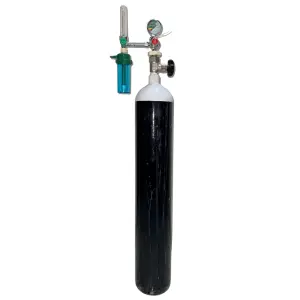
- A source — an oxygen cylinder, an oxygen concentrator, or both
- A regulator or flowmeter to control litres per minute
- A humidifier bottle where prescribed, to reduce nasal dryness
- A delivery device — nasal cannula, simple face mask, venturi mask or non-rebreather mask
- A pulse oximeter to check saturation
- A monitoring plan — who checks what, how often, and what triggers a phone call
- Backup arrangements — spare cylinder, power backup, and a supplier who answers at 3 a.m.
The equipment is the easy part. The plan around it is what keeps the patient safe, which is why we supply oxygen alongside nursing support rather than as a standalone delivery.
Oxygen Is a Medicine, Not a Comfort Item
This is the most important section in this article, and the one that most often surprises families.
Oxygen is prescribed like any drug: a specific flow rate, for a specific duration, aiming at a specific saturation range. It is not a tonic, it is not a general “strengthener,” and more is not automatically better.
Why turning the knob up can be dangerous. In patients with long-standing chronic lung disease — particularly COPD — the body may have adapted to higher carbon dioxide levels over years. Giving too much oxygen in these patients can reduce their drive to breathe and worsen carbon dioxide retention, which can lead to drowsiness, confusion and respiratory failure. This is exactly why doctors often set a deliberately modest target saturation for such patients rather than aiming for a “perfect” number.
The rule for families is simple and absolute:
- Give the flow rate the doctor prescribed.
- Do not increase it because the patient looks uncomfortable.
- If the patient needs more oxygen than prescribed to stay in range, that is a medical event requiring a phone call — not a knob adjustment.
- If the saturation is above the target range, do not reduce it on your own either. Report it.
A family in Tejgaon called us at night because their father seemed breathless; someone had already raised the flow from 2 to 5 litres. He was drowsy by the time our nurse arrived. He recovered fully — but the correct action at the first sign of breathlessness would have been a call, not a knob.
Understanding Oxygen Saturation and Target Ranges
The pulse oximeter number, SpO₂, estimates how much of the blood’s haemoglobin is carrying oxygen.
General reference points:
- 94–98% is a typical target for most adults without chronic carbon dioxide retention.
- 88–92% is commonly targeted for patients with COPD or others at risk of carbon dioxide retention, precisely to avoid over-oxygenation.
- Below 90%, and certainly below 88%, generally needs prompt clinical assessment.
- Below 85% with symptoms is an emergency.
These are general reference points, not your patient’s prescription. Your doctor sets the individual target based on the diagnosis, blood gas results and history. Write that target on a card and tape it to the wall beside the equipment, along with the prescribed flow rate. Everyone in the household, and every visiting caregiver, should be able to read it in three seconds.
Long-term oxygen therapy, when prescribed for chronic low oxygen levels, is usually intended for many hours a day — often fifteen or more — because the benefit comes from sustained use, not occasional relief. Patients who use it “only when breathless” often get far less benefit than the prescription intended.
Who Needs Oxygen Support at Home?
- COPD patients with chronically low oxygen levels
- Patients discharged from ICU who remain oxygen-dependent
- Post-COVID and post-pneumonia patients during extended recovery
- Heart failure patients with breathlessness and low saturation
- Interstitial lung disease and pulmonary fibrosis patients
- Advanced cancer patients with breathlessness, as part of palliative care
- Neuromuscular and post-stroke patients with weak respiratory effort
- Patients with tracheostomy or long-term airway support
- Asthma patients during severe episodes, under medical direction
- Bedridden patients prone to chest infection and low saturation
- Any patient a doctor has prescribed home oxygen for, whether short-term or lifelong
Signs a Patient May Need Oxygen
Only a doctor decides, but these are the signs that should prompt an urgent medical assessment:
- Breathlessness at rest, or with minimal effort like walking to the bathroom
- Pulse oximeter readings persistently below the patient’s usual range
- Rapid, shallow breathing, or visible effort using neck and shoulder muscles
- Blue or grey tinge to lips, tongue, fingertips or nail beds
- Confusion, agitation or unusual drowsiness
- Persistent morning headaches in a known lung disease patient
- Inability to complete a full sentence without pausing for breath
- Racing heartbeat with breathlessness
- Worsening breathlessness when lying flat
- Sudden deterioration in a patient with chronic lung or heart disease
Note that breathlessness and low oxygen are not the same thing. Some patients feel desperately breathless with normal saturation; others have dangerously low saturation and barely complain. Both need assessment — which is why measurement matters more than appearance.
Oxygen Cylinder vs Oxygen Concentrator
This is the decision every family faces first, and the right answer depends entirely on how the oxygen will be used.
Oxygen cylinder
Compressed medical oxygen in a steel cylinder, delivered ready to use with a regulator.
Strengths: works without electricity, delivers higher flow rates when needed, ideal for emergencies, short-term use, and as backup. Available quickly across Dhaka, often within an hour or two.
Limitations: it runs out and must be refilled or exchanged; heavy and awkward to move; requires careful handling and secure upright storage; ongoing refill cost and logistics for continuous users.
Oxygen concentrator
An electrical machine that takes room air, removes nitrogen and delivers concentrated oxygen continuously.
Strengths: never runs out while power is available, no refills, far more economical for long-term daily use, and simple for families to operate.
Limitations: completely dependent on electricity, has a maximum flow rate depending on the model, produces some noise and heat, needs filter cleaning, and has a higher upfront cost.
The practical answer for most Dhaka households
Use both. A concentrator as the primary source for continuous use, plus a cylinder standing by for load-shedding, equipment failure, hospital transfers and emergencies. Families who rely on a concentrator alone eventually meet a long outage at 2 a.m., and that is not the moment to start arranging a cylinder.
Setting Up the Room Safely
- Position the source sensibly — cylinder upright and secured against falling, concentrator with at least 15–30 cm of clear space around the air intake so it does not overheat.
- Keep tubing tidy and short enough to avoid trip hazards, but long enough for the patient to reach the toilet. Tape excess tubing along the skirting rather than leaving loops on the floor.
- Ventilate the room. An enclosed, oxygen-enriched space is a fire risk.
- Keep the equipment away from heat — no direct sunlight, no proximity to a stove, heater or electrical heat source.
- Set up the care corner: oximeter, spare cannula, humidifier water, the written flow rate and target saturation card, the observation chart, and emergency numbers.
- Plan the route to the door for a hospital transfer, including who carries the portable cylinder.
- Keep a torch beside the bed for outages.
We install and demonstrate all of this at delivery, because a concentrator pushed against a wall in a hot, closed room in Mirpur 2 is a machine that will fail on the day it matters.
Power Backup and Load-Shedding
This section is specific to Bangladesh, and it is not optional for any oxygen-dependent patient.
- Assume outages will happen at the worst time. Plan on that basis.
- Keep a full backup cylinder in the house for every concentrator user, with a regulator already attached and tested.
- Practise the switchover once, calmly, while the power is on. Every adult in the household should be able to do it in the dark.
- Connect the concentrator to an IPS or generator where possible, and confirm the unit can handle the machine’s load — concentrators draw meaningfully more power than a fan or a light.
- Consider a battery-backed portable concentrator for patients who must move around or travel.
- Keep supplier numbers visible, and choose a supplier with genuine 24-hour delivery rather than office-hours delivery advertised as 24-hour.
- Charge phones and torches whenever power is available.
Households in Kuril and other areas with longer outages should treat this as part of the medical plan, not as household inconvenience.
Fire Safety: The Rules That Are Not Optional
Oxygen does not burn by itself, but it makes everything around it burn far more fiercely and far faster. Household fires involving home oxygen are well documented worldwide, and they are almost always preventable.
- No smoking in the house. Not in the next room, not near a window. This applies to visitors, and it is worth saying to them directly.
- Keep oxygen at least 1.5–2 metres away from any open flame — gas stove, candle, oil lamp, mosquito coil, incense.
- No cooking while wearing a cannula, ever. This is the single most common near-miss we encounter.
- No oil-based products on the face or in the nose — petroleum jelly, mustard oil, oil-based balms. Use water-based lubricants only.
- No aerosol sprays near the equipment — air freshener, insect spray, deodorant, hairspray.
- Avoid synthetic and woollen blankets that build static; cotton bedding is safer.
- Check electrical wiring in the room, and never run a concentrator through an overloaded multi-plug.
- Keep a fire extinguisher or at minimum a bucket of water and a heavy blanket accessible.
- Tell your neighbours or building caretaker that oxygen is in use, so emergency responders know.
Print these rules and tape them beside the equipment. Household members forget; a sign does not.
Using a Pulse Oximeter Correctly
The number you act on is only as reliable as the way you took it. These errors are extremely common in home use:
- Nail polish, artificial nails or henna on the finger can distort readings — use a clean, bare finger.
- Cold hands reduce blood flow and give falsely low readings; warm the hand first.
- Movement or shivering produces unreliable numbers; stay still for the reading.
- Poor circulation, low blood pressure or anaemia affect accuracy.
- Bright overhead light shining on the probe can interfere.
- Take the reading properly: sit still, hand resting on the chest or table, wait until the number stabilises for 20–30 seconds, then record it with the time.
- Record the pulse rate too — the oximeter shows it, and it is clinically useful.
- Check the trend, not the single number. One low reading during a coughing fit means little; three consecutive falling readings mean a great deal.
- Never rely on the oximeter alone. A patient who looks unwell with a “normal” number still needs assessment.
Daily Equipment Care and Hygiene
- Humidifier bottle: use clean drinking water or distilled water, empty and refill daily, and wash the bottle regularly. Standing water grows bacteria straight into the patient’s airway.
- Nasal cannula: wipe daily, and replace regularly — typically every one to two weeks with normal use, and immediately after any respiratory infection.
- Masks: wash daily with mild soap, rinse thoroughly, air dry completely.
- Concentrator filters: clean the external filter weekly and let it dry fully before refitting. A clogged filter reduces oxygen output silently.
- Tubing: check for kinks, cracks and dampness; replace when discoloured or stiff.
- Skin care: check behind the ears, on the cheeks and inside the nostrils daily. Cannula tubing causes pressure sores on the ears surprisingly quickly — pad it with soft gauze if redness appears.
- Mouth and nose: dryness is common. Frequent sips of water, water-based nasal gel where advised, and good oral care help.
- Service the concentrator as the supplier recommends, and check its oxygen output periodically.
Warning Signs: When to Call and When to Rush
Call your nurse or doctor today
- Saturation drifting below the prescribed target despite correct flow
- Increasing breathlessness during normal daily activity
- New or worsening cough, or a change in sputum colour
- Fever
- Ankle swelling in a heart or lung disease patient
- Morning headaches, or unusual daytime sleepiness
- Sore, broken skin behind the ears or in the nostrils
- The patient needing oxygen for far more hours than usual
Emergency — seek immediate medical help
- Severe breathlessness, or gasping
- Blue or grey lips, tongue or fingertips
- Confusion, unresponsiveness or extreme drowsiness
- Saturation staying very low despite prescribed oxygen
- Chest pain with breathlessness
- Inability to speak more than a word or two
- Equipment failure with no backup available and a dependent patient
What Home Oxygen Costs and What Drives the Price
Prices in the Dhaka market move, so treat the following as orientation and confirm current figures when you book.
Broadly, the market works like this: a standard medical oxygen cylinder is a purchase running from the low thousands of taka for smaller or economy units to the mid-twenty-thousands for major international brands; monthly cylinder rental typically runs a few thousand taka; refills are comparatively inexpensive, with home delivery charged on top; and an oxygen concentrator is a larger one-time purchase, often in the tens of thousands of taka, or available on rental.
What drives your actual cost:
- Purchase versus rental — rental suits short-term needs; purchase makes sense for long-term daily use.
- Cylinder versus concentrator — for continuous long-term oxygen, a concentrator usually costs far less over months than repeated refills.
- Prescribed flow rate — high flow rates consume cylinders fast and multiply refill costs.
- Cylinder size and brand.
- Delivery timing — urgent night and holiday delivery may cost more.
- Accessories — regulator, humidifier, cannula, mask, trolley, oximeter.
- Nursing support — whether you also need a nurse for monitoring, suction or tracheostomy care.
The honest advice: if the prescription is short-term, rent. If it is long-term and continuous, do the arithmetic on refills over three months before buying anything — for most continuous users, a concentrator plus one backup cylinder is the cheaper and safer combination.
BENEFITS OF OXYGEN SUPPORT AT HOME
- Relief from breathlessness, the symptom patients fear most.
- Better oxygen delivery to vital organs — heart, brain, kidneys.
- Improved sleep, since night-time oxygen dips are corrected.
- More energy for daily activity, walking, bathing and eating.
- Reduced strain on the heart from chronic low oxygen.
- Fewer hospital admissions for patients whose oxygen is properly managed.
- Improved appetite and weight in patients previously too breathless to eat well.
- Better mental clarity, with less confusion from chronic hypoxia.
- Lower cost than an equivalent hospital stay for a stable patient.
- Lower infection risk than remaining in a crowded ward.
- Familiar surroundings, which reduce the anxiety that itself worsens breathlessness.
- Family presence without visiting-hour restrictions.
- Supported rehabilitation, since patients can exercise gently with oxygen in place.
- Palliative comfort for patients with advanced illness who wish to remain at home.
- Faster recovery after pneumonia, COVID and other respiratory illness.
- Continuous monitoring when combined with nursing support.
- Emergency readiness, with a backup cylinder already in the house.
- Reduced caregiver panic, because the household knows what to do.
- Documented readings that make every doctor’s review more useful.
- Dignity and independence for patients who would otherwise be hospitalised for months.
FEATURES OF OUR SERVICE
- 24/7 availability across Dhaka, including nights, weekends and holidays.
- Fast home delivery of oxygen cylinders for urgent needs.
- Oxygen cylinder rental, purchase and refill with flexible daily, weekly and monthly plans.
- Oxygen concentrator supply and rental, matched to the prescribed flow rate.
- Complete setup at home — regulator fitted, flow set, humidifier prepared, equipment positioned safely.
- Family demonstration and training on operation, switchover and fire safety.
- Accessories supplied — regulator, humidifier bottle, nasal cannula, masks, trolley, pulse oximeter.
- Backup cylinder arrangement for concentrator users, with load-shedding planning.
- Refill and exchange service with rapid response across the city.
- Registered nurses for monitoring, suction, tracheostomy care and nebulisation.
- Pulse oximetry monitoring and written charting on every nursing visit.
- ICU setup at home for high-dependency respiratory patients.
- Doctor home visits for review when the patient’s needs change.
- Home sample collection for tests during a respiratory illness.
- Trained caregivers for bedridden and dependent respiratory patients.
- Suction machine, nebuliser, hospital bed and air mattress rental from the same team.
- Physiotherapy at home, including chest physiotherapy and breathing exercises.
- Equipment servicing and filter checks during the rental period.
- Transparent, itemised pricing confirmed before delivery.
- Coordination with your treating doctor, following the prescription exactly.
SAFETY TIPS FOR FAMILIES
- Never change the prescribed flow rate on your own initiative, in either direction.
- No smoking, no flames, no cooking while oxygen is running. Enforce this with visitors too.
- Use only water-based products on the face and in the nose.
- Keep a full backup cylinder and know how to switch over in the dark.
- Secure the cylinder upright so it cannot fall; a falling cylinder with a damaged valve is genuinely dangerous.
- Record readings at the same times daily so trends are visible.
- Keep the concentrator’s air intake clear and the room ventilated.
- Replace cannulas regularly and after any infection.
- Check the skin behind the ears and inside the nostrils every day.
- Keep emergency numbers, the target saturation and the flow rate on a card taped beside the bed.
- Never store oxygen in a hot car or in direct sunlight.
COMMON MISTAKES TO AVOID
- Turning up the flow because the patient looks breathless — potentially dangerous, especially in COPD.
- Using oxygen only when symptoms appear when the doctor prescribed continuous use.
- Relying on a concentrator with no backup cylinder in a city with load-shedding.
- Letting the cylinder run to empty instead of refilling at the quarter mark.
- Applying petroleum jelly or oil to dry nostrils while on oxygen.
- Leaving the humidifier bottle unwashed for days, breeding bacteria into the airway.
- Ignoring pressure sores developing behind the ears from cannula tubing.
- Trusting a single oximeter reading taken on a cold, moving or polished finger.
- Buying a concentrator with a maximum flow below the prescription, so it can never deliver the required dose.
- Cooking or lighting a mosquito coil in the same room as running oxygen.
- Never recording anything, so the doctor has no trend to review.
- Choosing a supplier without genuine night-time response, discovered at the worst possible moment.
PROFESSIONAL ADVICE FROM OUR NURSING TEAM
Write the prescription on the wall. Flow rate, target saturation range, hours per day, and the doctor’s number. Households have multiple people, night shifts and visitors — memory is not a system.
Buy the oximeter, and learn to use it properly. It is inexpensive and it turns guesswork into information. Take readings at fixed times, record them, and bring the chart to every appointment.
Do the three-month arithmetic before buying equipment. For a patient on continuous oxygen, repeated refills usually cost more over a few months than a concentrator. For a patient needing oxygen for two weeks after pneumonia, renting a cylinder is obviously right. Any supplier who pushes the expensive option regardless of the prescription is selling, not advising.
Treat load-shedding as a medical risk. We have delivered emergency cylinders at 2 a.m. to families in Sabujbagh and elsewhere whose concentrator stopped during an outage. Every one of those calls was preventable with a backup cylinder standing in the corner.
Combine oxygen with chest physiotherapy where appropriate. Breathing exercises, positioning and secretion clearance often improve a patient’s saturation more than any increase in flow would — and unlike flow, they carry no risk.
Ask for review, not just supply. Oxygen needs change. Patients recovering from pneumonia often need far less after a few weeks; patients with progressive disease may need more. A prescription set three months ago should not run unreviewed for a year.
CONCLUSION
For a patient who cannot breathe comfortably, oxygen is the difference between a day spent gasping and a day spent living — eating a meal, talking to grandchildren, sleeping through the night. That is why families arrange it so urgently, and why they deserve better information than a phone number and a delivery time.
Oxygen support at home works when three things are in place: the right equipment for the prescription, a household that understands the rules, and a supplier who answers the phone at 3 a.m. with a cylinder in a van. Get those three right and home becomes a genuinely safe place for a respiratory patient — cheaper than a hospital bed, kinder, and far less lonely.
If a doctor has prescribed oxygen for someone in your family, arrange it properly from the start. Ask what flow rate, ask what target range, ask what happens during a power cut, and ask who trains your household. The equipment is the easy part; everything around it is what keeps your patient safe.
PEOPLE ALSO ASK
- What is oxygen support at home? Doctor-prescribed oxygen therapy delivered at the patient’s residence through a cylinder or concentrator, with a set flow rate and monitored saturation.
- Which is better, an oxygen cylinder or a concentrator? A concentrator suits continuous long-term use; a cylinder suits short-term, emergency and backup needs. Most households on continuous oxygen need both.
- How long does an oxygen cylinder last? Divide the cylinder volume by the flow rate — a full standard 2,000-litre cylinder lasts roughly 16 hours at 2 litres per minute and about 6–7 hours at 5.
- What oxygen level is dangerous? Individual targets vary, but persistent readings below 90%, and certainly below 88%, need prompt medical assessment; very low readings with symptoms are an emergency.
- Can I increase the oxygen flow if the patient feels breathless? No. The flow rate is prescribed, and increasing it can be dangerous in some lung disease patients. Call the doctor instead.
- Do oxygen concentrators work during load-shedding? No, they need continuous electricity. Keep a backup cylinder and, where possible, an IPS or generator connection.
- Is home oxygen safe? Yes, when the prescription is followed, fire rules are respected and the equipment is properly maintained and monitored.
- How much does an oxygen cylinder cost in Bangladesh? Prices vary by size, brand and whether you rent or buy, and refills are charged separately. Ask for current rates when booking.
- What is the correct way to use a pulse oximeter? Clean bare finger, warm hand, sit still, wait for the reading to stabilise, and record the number with the time.
- Can a nurse manage oxygen therapy at home? Yes, registered nurses monitor saturation, manage equipment, provide suction and tracheostomy care, and escalate when the patient deteriorates.
FREQUENTLY ASKED QUESTIONS
1. How quickly can you deliver oxygen to my home? Urgent cylinder delivery across Dhaka is usually possible within a short window, day or night. Call and confirm for your address.
2. Do you rent as well as sell? Yes — cylinders and concentrators are available on daily, weekly and monthly rental, or for purchase.
3. Do you provide the regulator, humidifier and cannula? Yes, complete setups including regulator, humidifier bottle, tubing, cannula or mask, and trolley where needed.
4. Will someone install it and show us how to use it? Yes. Our team installs, sets the prescribed flow, checks the room for safety and trains the family before leaving.
5. What flow rate should we use? Only what the doctor prescribed. We will supply equipment capable of delivering it, but we never set a rate the prescription does not specify.
6. What happens during load-shedding? Concentrators stop without power. We arrange a backup cylinder and train the family in switchover; an IPS or generator connection is strongly recommended.
7. Do you provide refills? Yes, refill and exchange service is available across Dhaka, including at night.
8. Can you supply a nurse along with the oxygen? Yes. Registered nurses can monitor saturation, provide suction, manage tracheostomy care and handle injections or full shift care.
9. Do you supply portable oxygen for hospital visits? Yes, portable cylinders are available for transfers, appointments and short outings.
10. Can you also provide a suction machine or nebuliser? Yes, along with hospital beds, air mattresses, wheelchairs and other equipment.
11. Is a prescription required? Oxygen should always be used on a doctor’s prescription. Share it with us so we can supply equipment matched to the prescribed flow.
12. How do we know when the cylinder needs refilling? Check the pressure gauge daily and arrange a refill at roughly one quarter remaining — never wait until it is nearly empty.
13. Do you serve all areas of Dhaka? Yes, across the city. Share your address and we will confirm the delivery time.
14. What if the patient improves and no longer needs oxygen? Tell us and we will collect the equipment and stop the rental. We reassess with your doctor rather than continuing indefinitely.
15. How do we book? Call Nursing Home Care Service or message through with the prescription details and your address.
CALL TO ACTION
Doctor prescribed oxygen? Get it set up properly, not just delivered. Tell us the flow rate and the diagnosis. We will recommend the right equipment, install it safely, train your household, and arrange nursing support if you need it.
📞 Call Now · 🫁 Book Oxygen Support at Home · ⚙️ Rent Medical Equipment · 🏠 Book Home Nursing · 🩺 Request a Nurse · 🛏️ Book ICU Setup at Home
Nursing Home Care Service — fast, safe and affordable oxygen support at home across Dhaka, 24 hours a day.